
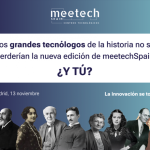
Effectia joins meetechSpain 2025 as a partner organisation at the business and technology innovation forum
29 de September de 2025
AI beyond the laboratory: challenges and prospects for accelerating advanced therapies
29 de October de 2025Effectia joins meetechSpain 2025 as a partner organisation at the business and technology innovation forum
29 de September de 2025AI beyond the laboratory: challenges and prospects for accelerating advanced therapies
29 de October de 2025Analysis, Strategic planning and evaluation
· 1 de October de 2025
Team and documentation: the foundations of a strong Severo Ochoa and María de Maeztu application
Taking part in a competitive research call for the “Severo Ochoa Centres of Excellence” and “María de Maeztu Units of Excellence” accreditations and public funding is a strategic opportunity to position an institution as a benchmark for scientific leadership and international reach.

Every section of the application reflects the excellence of the team, the organisation’s capacity for innovation and its vision for the future. Standing out from other proposals requires more than meeting the formal requirements: the application needs a strong, coherent and ambitious narrative that inspires confidence among evaluators and demonstrates the qualitative leap the institution is prepared to make.
Below are some key considerations for building a strong and competitive application for the Severo Ochoa and María de Maeztu calls.
Team: aligned with the call
First, the organisation as a whole must be aligned with the call, beyond the individual researchers selected as guarantors. This requires effective communication between the scientific director, the research team and the rest of the organisation.
In this respect, the first step in preparing the application is to select the scientific director and the team of guarantors. This group is particularly important and should:
- Include members of the centre or unit with the strongest international scientific profile, with particular emphasis on academic leadership and participation in European projects and technology transfer.
- Aim for gender balance within the team.
- Ensure that the scientific director and guarantors are not close to retirement by the project end date.
Documentation: complete, concise and coherent
The purpose of the call is to encourage institutions to take a genuine step forward and move beyond their comfort zone. Action plans should therefore not simply continue existing activity, but set out a profound transformation of the organisation.
One of the main challenges in preparing the required documentation is the character limit, which needs to be considered before drafting begins. If teams first write lengthy proposals with the intention of shortening them later, the final text may contain inconsistencies that reduce the application’s score.
The call documentation and application platform also specify a series of topics that must be covered in each section. It is essential to address all of them; otherwise, evaluators may deduct points from the application.
Two fundamental elements of the documentation are the research report and the strategic plan. The following sections outline some essential guidelines to ensure that both documents are aligned with the objectives of the application.
Research report:
Within the research results section, the 10 most significant contributions must be selected. When doing so, the Publications Analysis chapter in Annex I should be kept in mind, with the aim of completing as much of the table in that annex as possible.
Preparing this annex is one of the most time-consuming stages of the process. Gathering the necessary data alone may require one person working full time for at least two months. In the benchmarking section of the annex, the comparison should clearly include information not only on academic performance but also on human and financial resources, among other factors. The comparisons should also be justified using ratios between the categories presented.
Strategic plan
As noted above, these calls need to be prepared well in advance. Experience shows that proposals developed only one or two months before the deadline tend to receive significantly lower scores than those shaped through at least six months of sustained work.
The action plan must be coherent and grounded in the experience of the team (the guarantors and scientific director). The research positions requested must also be clearly linked to the lines of activity defined in the plan.
It is equally important to define the plan’s strategic lines carefully: they should strengthen synergies between the selected research areas or, where appropriate, open up a new line with the potential to reinforce the scientific leadership of the unit or centre.
Academic, human-resources, technology-transfer and international-collaboration objectives should be clearly stated in the relevant sections using implementation indicators. These indicators must also be included in the corresponding section of Annex II. With regard to international collaboration, it is worth considering which new partners could help deliver the strategic plan’s objectives rather than limiting the approach to already established collaborations.
Ultimately, applying to the Severo Ochoa and María de Maeztu calls requires much more than meeting formal requirements: it means articulating an ambitious vision capable of positioning the institution at the forefront of international science. A well-prepared application, aligned with the centre’s strategy and backed by a strong team, not only increases the likelihood of success in the evaluation process but also becomes a long-term tool for positioning and differentiation.
Along the way, the support of a specialist strategic consultancy can make a real difference by bringing methodology, an external perspective and experience of similar processes. This can help maximise the coherence of the proposal, optimise resources and strengthen the competitiveness of the application. Investing in excellence, rigorous planning and an innovative proposal is ultimately an investment in the future and in consolidating the organisation’s scientific leadership.