
Effectia addresses territorial innovation strategies and research talent at Transfiere 2026
12 de February de 2026
Effectia presents the key changes to the HR Excellence in Research Award at Transfiere 2026
3 de March de 2026Effectia addresses territorial innovation strategies and research talent at Transfiere 2026
12 de February de 2026Effectia presents the key changes to the HR Excellence in Research Award at Transfiere 2026
3 de March de 2026Insights, Technology transfer
· 27 de February de 2026
Spain’s autonomous regions explore how to drive knowledge transfer and territorial impact at Transfiere 2026
The “Territorial Innovation Strategies” panel, moderated by Effectia, brought together five autonomous regions to discuss how public innovation policy can be translated into real territorial impact.
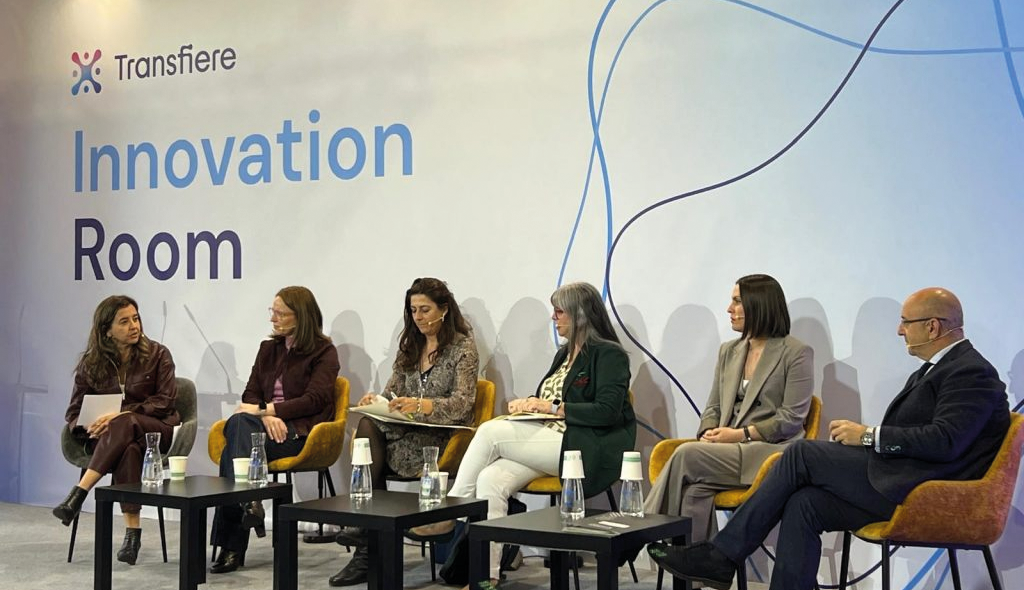
“Territorial Innovation Strategies” panel at Transfiere 2026.
As part of #Transfiere2026, the “Territorial Innovation Strategies” panel examined how Spain’s autonomous regions are promoting knowledge transfer and generating territorial impact through public innovation policies.
The session was moderated by Lorena Muñoz Vivas, CEO of Effectia, and featured Migdalia Machín Tavío, Minister for Universities, Science, Innovation and Culture of the Government of the Canary Islands; Marina Villegas Gracia, Director General for Research and Technological Innovation of the Community of Madrid; Carmen Cotelo Queijo, Director of the Galician Innovation Agency (GAIN); Lourdes Puigbarraca, Deputy Director of the Directorate-General for Transfer and the Knowledge Society of the Government of Catalonia; and Juan José Cortés Vélez, Director General for Innovation at the Valencian Regional Ministry of Industry, Tourism, Innovation and Trade.
The discussion highlighted how territorial innovation has become a key driver of economic, social and technological progress, and how regional governments are aligning their strategies to generate real value for citizens.
Strategies rooted in regional identity
From the Canary Islands, Migdalia Machín Tavío highlighted how the archipelago is consolidating its position as an Atlantic innovation hub, supported by strategic areas such as the blue economy, aerospace, water and energy. She also highlighted the role of the Institute of Astrophysics of the Canary Islands, leadership in efficient desalination and the use of the territory as a natural laboratory for international scientific projects.
Representing the Community of Madrid, Marina Villegas Gracia noted that although Madrid already leads in innovation, the goal is to go further in knowledge transfer by scaling technology companies through collaboration between large corporations, SMEs and research centres, supported by sector clusters and talent-attraction programmes such as the Gabriela Morreale programme linked to the IMDEA institutes.
For the Valencian Government, Juan José Cortés Vélez argued that innovation is now the new way to compete. The Valencian strategy rests on three pillars: developing talent and opportunities, providing infrastructure for effective transfer, and pursuing innovation that delivers economic and social returns, with technology institutes acting as the “R&D&I departments” of SMEs.
From Galicia, Carmen Cotelo Queijo focused on talent as the main asset of the Galician ecosystem, highlighting programmes such as Oportunius, industrial doctorates and sustained investment in biotechnology, quantum computing and artificial intelligence. Galicia is moving “from scientific tradition towards cross-cutting innovation”, supported by technology centres, clusters such as BIOGA and anchor companies.
Catalonia presented a strategy based on consistency and the real impact of policy instruments. Lourdes Puigbarraca described a multilevel governance model coordinating research centres, universities, hubs and companies, supported by stronger transfer offices (OTCs), calls targeting higher Technology Readiness Levels (TRL 6–8) and the early integration of companies into scientific projects.
Innovation with real impact
“These kinds of meetings are extremely valuable for sharing strategies and good practices that help innovation deliver real impact across regions.”
Lorena Muñoz Vivas, CEO of Effectia
The panel concluded by highlighting a shared vision that cuts across regional differences: aligning talent, infrastructure, governance and public-private collaboration so that innovation generates not only economic growth, but also prosperity and wellbeing for citizens.