

Sagrario Mochales, the woman who discovered Spain’s first antibiotic
8 de March de 2024
Effectia to design a new Research Centre on Ageing in Álava
9 de April de 2024Sagrario Mochales, the woman who discovered Spain’s first antibiotic
8 de March de 2024Effectia to design a new Research Centre on Ageing in Álava
9 de April de 2024Insights, Strategic planning and evaluation
· 22 de March de 2024
Transfiere Forum round table highlights the challenge of attracting and developing research and innovation talent for public administrations and companies
The panel included José Manuel Pingarrón, Secretary General for Universities at the Ministry of Science, Innovation and Universities; Eloisa del Pino, President of the Spanish National Research Council (CSIC); Lluis Rovira, an HRS4R European Award assessor and former director of CERCA in Catalonia; and Jorge Barrero Fonticoba, Director General of the Cotec Foundation for Innovation. The discussion was moderated by Effectia CEO Lorena Muñoz.
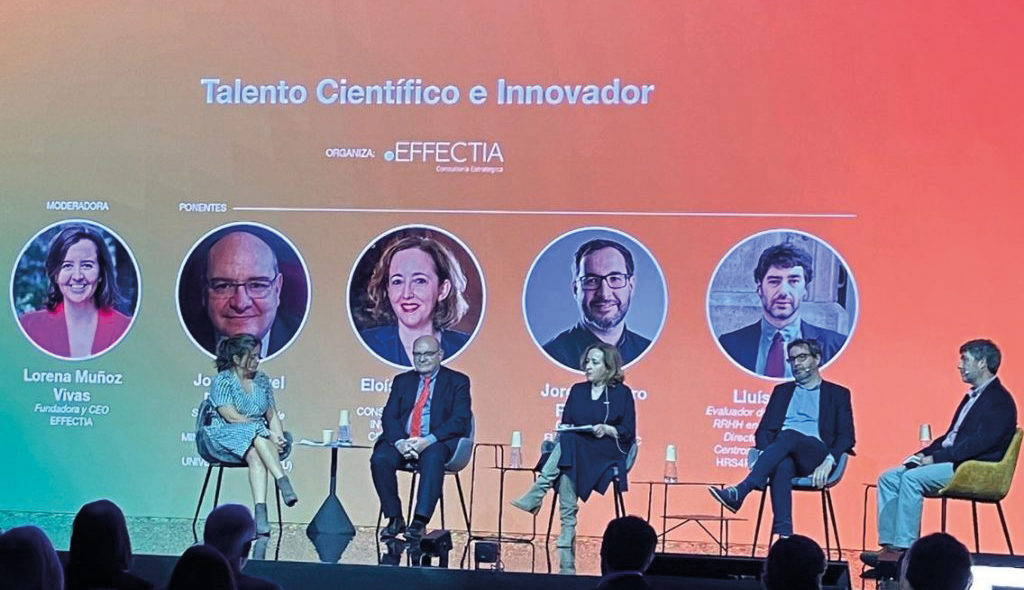
Lorena Muñoz, José Manuel Pingarrón, Eloisa del Pino, Jorge Barrero Fonticoba and Lluis Rovira.
The Transfiere Forum held in Málaga hosted a round table on research and innovation talent on 20 March, organised with the support of Effectia. Its conclusions highlighted one of the major challenges ahead: attracting and developing talent, both for public-sector organisations carrying out research and innovation and for companies that increasingly require highly specialised skills.
The panel included José Manuel Pingarrón, Secretary General for Universities at the Ministry of Science, Innovation and Universities; Eloisa del Pino, President of the Spanish National Research Council (CSIC); Lluis Rovira, an HRS4R European Award assessor and former director of CERCA in Catalonia; and Jorge Barrero Fonticoba, Director General of the Cotec Foundation for Innovation.
Effectia CEO Lorena Muñoz moderated a discussion on how talent development is regulated and incentivised, what research institutions and private companies look for in researcher profiles, and how researchers should prepare for the labour market ahead: which technical and soft skills they will need to develop in order to adapt to the future of research.
The challenge of research and innovation talent: demand and skills
José Manuel Pingarrón noted that a major challenge is enabling research staff to achieve stable employment earlier in their careers. He added that the public sector finds it difficult to compete with companies on salary, although it can offer other highly valued benefits such as job stability. He pointed out that recent legislation goes further in addressing these issues and stressed the importance of industry also absorbing PhD holders into its workforce.
Lluis Rovira highlighted that “Europe is trying to connect the entire European area and encourage researchers to consider careers in the private sector, and that is progressing quite well”. He recalled that the HR Excellence in Research Award (HRS4R) also reflects the multifactorial nature of talent management: it is not enough for a Member State to pass a good law or for a centre to launch grants to attract talent, because “it is an ecosystem issue and needs to be viewed from a broad perspective”. Rovira advocated identifying distinctive strengths at European level and building on them, adding that “we need bold policymakers to support these initiatives”. He also noted that the European Commission is working towards greater recognition of careers in technology-transfer management as a way of attracting talent into these areas.
Jorge Barrero argued that, in his view, “a PhD qualifies someone to carry out research, but expecting any economy to absorb every PhD it trains is not very realistic”. He acknowledged that “companies do have demand”, while noting that leading companies are finding that “the talent they have moves to less cutting-edge sectors that pay better”. COTEC recently published a technology-employment map which, according to its director, “shows that the shift in the productive model is already a reality”. The data support this: technology employment grew by 47.7% over the last decade, almost twice the average growth recorded across the rest of the economy, at 26.4%.
Eloisa del Pino said that “we are at a crossroads” when it comes to researcher and scientist profiles: “we ask ourselves what skills the scientists of the future will need, and we are approaching this more in terms of team skills because the demands placed on any one individual are simply too great”, given the breadth of knowledge now required to carry out research.
The impact of Artificial Intelligence on the future of work
All speakers also expressed concern about the impact of Artificial Intelligence (AI) on future professional profiles and agreed that it will change many things, from the way we write to the way we interact. They also agreed that research centres will need AI specialists. Meeting that demand will require more training and investment to enable AI experts to work across centres in a cross-cutting capacity.
The Secretary General for Universities at the Ministry of Science, Innovation and Universities concluded on an optimistic note, arguing that human contribution will remain essential and citing the human interaction required in professions such as medicine. The European HRS4R assessor, meanwhile, called for clearer guidelines on scientific integrity in relation to AI, at least for research and innovation funded with public money.
For COTEC’s Director General, AI will be able to bring new approaches, and he hopes that some of its effects, such as automation, will help ensure that attracting research and innovation talent does not depend on other, more technical skills. The President of CSIC announced that the organisation is working to create “a very strong training department, not so much to deliver specific training as to bring together training from other sectors”, with a particular focus on Artificial Intelligence.
As part of the Transfiere Forum programme, Effectia Innovation Solutions organised two workshops focusing on human resources and research excellence, and on knowledge transfer and funding for spin-offs.