

Effectia presents the key changes to the HR Excellence in Research Award at Transfiere 2026
3 de March de 2026
GUIDE | HR Excellence in Research 2026: what’s new
25 de March de 2026Effectia presents the key changes to the HR Excellence in Research Award at Transfiere 2026
3 de March de 2026GUIDE | HR Excellence in Research 2026: what’s new
25 de March de 2026Insights, Strategic planning and evaluation
· 25 de March de 2026
What’s new in HR Excellence in Research: understanding how the European model is evolving
Research talent management continues to establish itself as one of the strategic pillars of the European Research Area. In this context, the European Commission’s Human Resources Award (HRA) continues to evolve in response to new challenges across the research and innovation ecosystem.
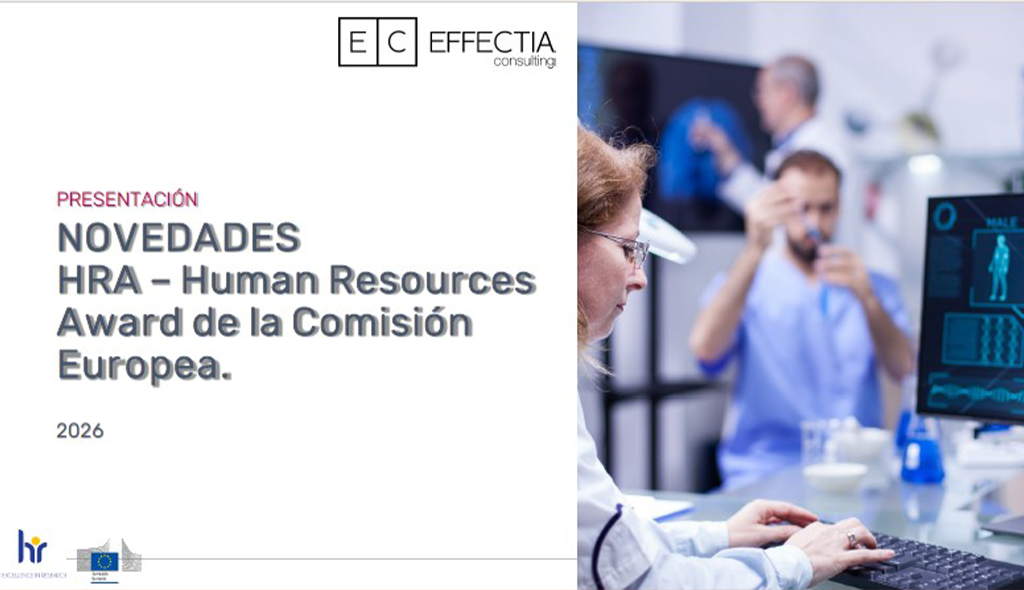
In 2026, significant changes are being introduced that affect both the strategic approach and the operational side of the process. These updates aim to strengthen researchers’ career paths and improve the functioning of Europe’s research labour market by promoting mobility, transparency and equal opportunities across Europe.
Below, we review some of the main developments that will shape the immediate future of research institutions.
Towards a simpler, more integrated and talent-focused model
Among the most relevant changes are new recommendations on professional development, working conditions and recruitment practices that are more closely aligned with the principles of the European Charter for Researchers and the Code of Conduct for the Recruitment of Researchers.
One of the main developments is the creation of the ERA Talent Platform, a one-stop gateway bringing together key tools such as EURAXESS and the HR Excellence in Research award itself. This step reinforces Europe’s commitment to making it easier to attract and mobilise research talent in an increasingly competitive environment.
Another significant change is the simplification of the European Charter for Researchers and Code of Conduct framework, which is reduced from 40 to 20 principles. The aim is to make the model more operational and better aligned with current priorities such as open science, equality and sustainability, facilitating implementation within institutions.
The process is also being updated through new digital tools and changes to evaluation in order to improve efficiency and reduce timelines. There is also a stronger focus on competency development for both researchers and R&D&I managers, further professionalising the system. In parallel, initiatives such as RESAVER continue to support researcher mobility by addressing one of the sector’s major challenges: the portability of pension rights in an international context.
Taken together, these developments reflect a clear evolution of the HRA towards a more strategic, people-centred model adapted to the current challenges of the European Research Area. The changes are designed not only to improve the quality of research in Europe, but also to ensure that researchers can plan and develop sustainable, competitive careers.
Practical guide to the latest HR Excellence in Research developments
Aware of the complexity involved in adapting institutions to these developments, at Effectia we have prepared a practical guide summarising the main changes, explaining their impact and providing concrete recommendations for effective implementation. The guide is designed as a useful resource for both research managers and human resources teams, offering a clear approach to preparing institutions for the new HR Excellence in Research requirements.